Towing Service
Flatbed Towing for Calgary Cars and SUVs
Your vehicle rides on the deck rather than on its own wheels. Flatbed transport for cars, SUVs, crossovers, minivans, motorcycles, and small trucks, available 24 hours a day.
What flatbed towing means
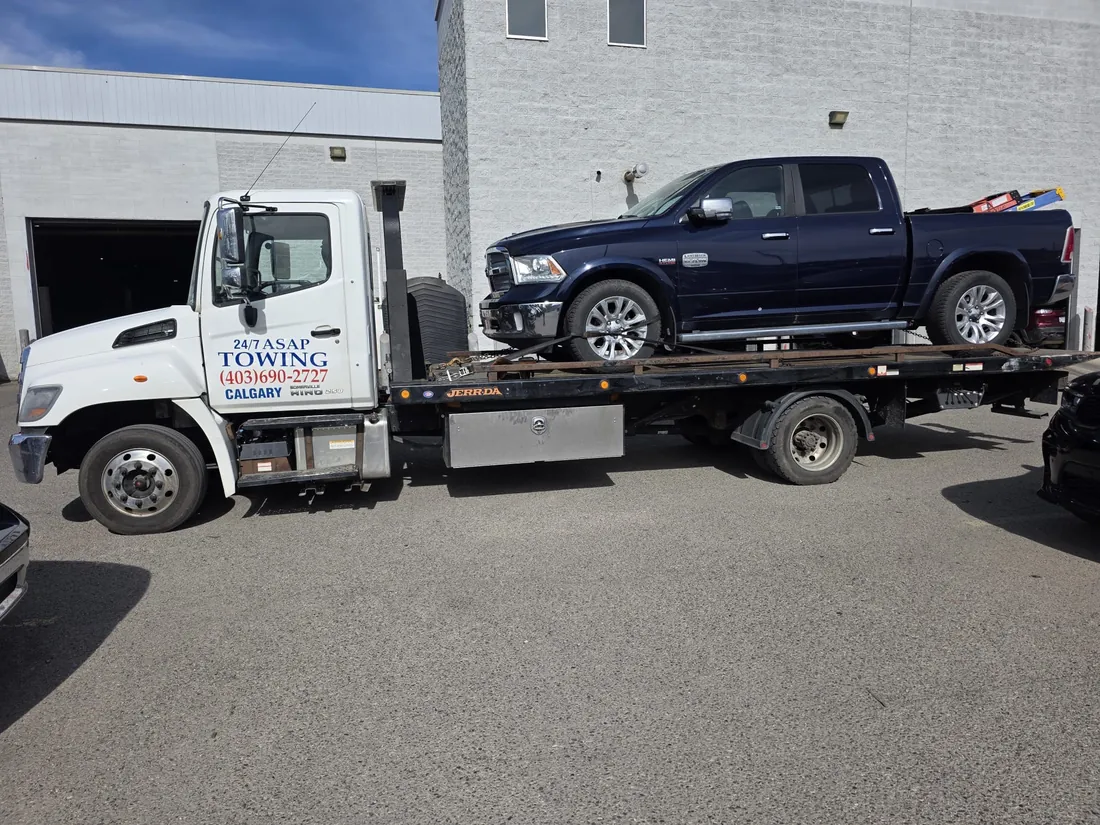
A flatbed tow truck carries a long, level deck. Hydraulics tilt it until the rear edge meets the pavement, turning it into a ramp. The vehicle is winched or driven up, secured, and the deck levels out for the drive.
Nothing touches the road
That is the point. With a wheel-lift truck one axle stays on the pavement and keeps turning the whole trip. On a flatbed all four wheels are off the ground, so distance and highway speed stop mattering, and a drivetrain fault that would make a wheels-down tow risky stops being a factor.
Why it is our default
Some operators treat flatbed transport as a premium add-on. We built the service around it, because the vehicles we are called to most often — all-wheel-drive crossovers, cars with brake or drivetrain faults, lowered cars, and collision-damaged vehicles — are the ones it suits best.
When flatbed transport is the right call
Whether a particular vehicle can be loaded depends on its condition, position, dimensions, access, and safe working space. These are the situations where the method itself is the better fit.
All-wheel drive and four-wheel drive
AWD and 4WD systems are built around all four wheels rotating together. Lifting one axle and leaving the other turning can load the centre differential or transfer case in a way the manufacturer did not intend; many owner's manuals say the vehicle should be transported with all wheels off the ground.
Lowered and low-clearance cars
Aftermarket suspension and deep front lips leave little room for a hookup. A tilting deck's low approach angle is more forgiving, though a very low front end can still be tight.
Vehicles that should not roll
A seized brake, a damaged wheel or hub, a transmission stuck in park, or a flat with no usable spare all rule out moving the vehicle on its own wheels.
After a collision
Once the scene is safe, a damaged vehicle is generally better loaded than dragged. Whether it can be loaded depends on the damage and where it has come to rest. Our emergency towing page covers what to do first.
Before the truck arrives
- Park as far from moving traffic as you safely can, and switch on your hazard lights.
- Stay out of live lanes — behind a barrier is safer than inside the vehicle.
- Have the keys ready.
- Clear anything you need out of the cabin and trunk, in case the vehicle goes somewhere closed.
- Note anything unusual about how it is sitting — a wheel at an odd angle, fluid underneath.
- Decide where it is going. A shop, a dealership, or home all work.
How a flatbed call works
Tell us what you have
Call 403-690-2727 or send a request with the vehicle make and model, where it is, what it is doing, and whether it still rolls and steers.
We confirm it is a light-duty job
If the vehicle is outside what our equipment handles, we say so on the call rather than sending a truck that cannot load it.
The truck comes to you
The operator checks the ground, the access, and the space available before positioning and tilting the deck.
Loading and transport
The vehicle is loaded and secured, then travels on the deck to the destination you chose.
What a flatbed cannot do
- We do not operate medium-duty or heavy-duty equipment. Commercial trucks, buses, RVs, and machinery are outside our range.
- Loading depends on access. A vehicle in a tight parkade, boxed in, or on an unstable surface may not be reachable.
- Not every vehicle can be loaded. Condition, position, dimensions, and safe working space all decide it, and severe damage may call for specialised recovery equipment instead.
- We cannot quote a fixed arrival time — it depends on your location, traffic, and what else is active.
- We do not perform repairs. A flatbed moves the vehicle; diagnosis happens at the shop.
Related services
A flatbed is not always the first thing you need.
Emergency Towing
Breakdowns and urgent situations, 24 hours a day. Start here if the vehicle is somewhere it should not be sitting.
Roadside Assistance
A boost, a spare, a lockout, or fuel can sometimes solve the problem without the vehicle leaving at all.
All Towing Services
Local trips, longer hauls, and tows to the mechanic of your choice.
Where we tow
Flatbed towing covers Calgary and the surrounding communities.
Request flatbed towing
Calling is fastest and lets us ask about access and condition straight away. The form suits anything that is not urgent.
Frequently Asked Questions
Is flatbed towing better than a wheel-lift tow for my car?
For most light-duty vehicles it is the gentler option, because no wheels turn during the trip. It matters most on all-wheel-drive and four-wheel-drive vehicles, where towing with one axle on the road can strain the drivetrain. On a front-wheel-drive car with no mechanical fault, either method can work — flatbed is simply what we operate.
Can you load a vehicle that won't roll or steer?
Sometimes, but not always. A winch can pull a vehicle that will not start. Whether one that will not roll or steer can be loaded depends on the fault, how and where it is sitting, and the room available to work. Describe the problem when you call.
Is a motorcycle something you can move?
A bike sits inside the light-duty range, so yes. Say so when you call though — strapping a motorcycle down is a different job from strapping down a car, and the operator should know before leaving.
Will a lowered car clear the ramp?
Often, yes. A tilting deck sits much closer to the ground than a wheel-lift hookup, which is why lowered cars are commonly moved this way. Very low front splitters can still be tight, so mention the ride height when you call.
Need a flatbed in Calgary?
Call and describe the vehicle and where it is — we'll tell you what we can do before a truck is dispatched.